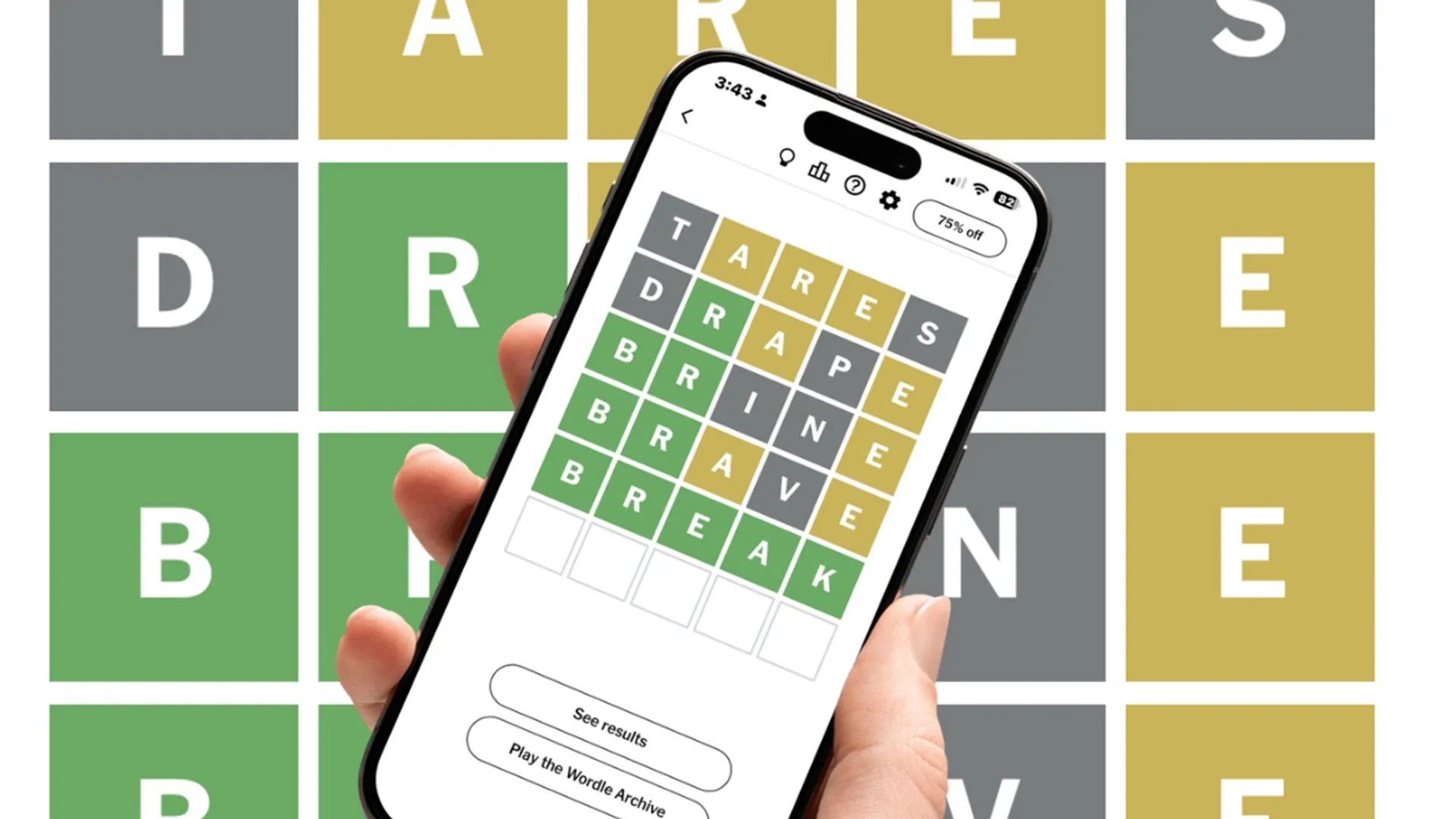
The Mathematics That Cracks Wordle — And Why It Changes Everything
Imagine spending years studying the fundamental limits of information while simultaneously watching your Wordle streak evaporate to a casual competitor thanks to a perfectly calculated guess. This isn’t science fiction—it’s the reality emerging from recent research at Binghamton University, where mathematicians have turned a beloved daily game into a showcase of entropy optimization.
A Radical Shift in Problem‑Solving Philosophy
What makes this breakthrough particularly fascinating is the complete inversion of conventional wisdom. Most puzzlers chase the quickest route to victory, favoring words that seem most plausible given past clues. Wu and his team argue that speed matters far less than the quality of each individual guess. Their mathematical framework, rooted in Shannon entropy, measures precisely how much uncertainty each potential response reduces from the pool of possibilities. When a candidate word cleanly partitions the remaining answers into tiny, manageable clusters, it delivers maximum information regardless of whether that word itself is the final solution.
Personally, I find this insight deeply unsettling because it challenges our innate belief that efficiency equals correctness. We tend to equate fast solutions with smart ones, yet the research shows otherwise. The algorithm deliberately selects words that might never crack the code outright, only because their feedback pattern promises clearer pathways ahead. This mirrors a broader truth in complex systems: sometimes the best course isn’t the one that gets you somewhere quickly, but the one that reveals the terrain more accurately.
A critical misconception persists among players: that frequency beats strategy. High‑frequency letters like A, E, and R dominate traditional advice because they appear constantly in English text. Yet frequency alone offers a shallow view of usefulness. Information theory accounts for positional dynamics, letter interactions, and the cascading effect of elimination. In simulation runs, the information‑theoretic approach shines brightly—solving nearly every puzzle at 99 percent accuracy—while the old reliable method falls short at 90 percent. The numbers speak louder than any intuition ever could.
From Backyard Experiment to Academic Publication
The story behind this research reads like a classic case study in applied mathematics. An assistant professor at Binghamton assigned her graduate students a modest homework task: prove that information theory could outperform traditional heuristics in a real‑world setting. What began as an academic exercise evolved into a peer‑reviewed paper titled "Solving Wordle Using Information Theory."
From my perspective as someone who spends countless hours dissecting linguistic patterns, this journey underscores how interdisciplinary thinking reshapes both theory and practice. The university’s School of Systems Science and Industrial Engineering cultivates exactly this kind of environment—a place where abstract formulas meet concrete outcomes. Students learn not merely equations but reasoning frameworks that transform a popular pastime into a rigorous experiment. Such projects are becoming rarer, which explains why breakthroughs in applied fields often take longer than expected.
I’m curious about scaling these successes. Could a crowd of players worldwide collectively train a model that learns optimal guessing strategies over time? The ethical questions that follow are equally intriguing: if personalized solvers democratize expertise, who ensures fair access? Who guards against manipulation? These considerations deserve equal weight alongside the mathematical elegance of the work.
Implications Beyond the Five‑Letter Grid
Beyond the confines of a five‑letter grid, the methodology demonstrates broader principles applicable to any iterative decision problem. Medical diagnostic pipelines rely on successive tests that generate preliminary signals, which later examinations build upon. Urban planners navigate evolving data streams, adjusting infrastructure investments based on accumulating evidence. In each case, treating every guess as a source of incremental knowledge yields superior outcomes compared to relying solely on static statistics or heuristic shortcuts.
Culturally, this research prompts reflection on the nature of expertise itself. For generations, practitioners have favored rule‑of‑thumb strategies—remember top‑frequency vowels, prioritize common trigram sequences—as paths to competence. Yet the computer consistently disproves this assumption. The discomfort many players feel when deviating from accepted tactics stems not from ignorance but from resistance to replacing intuition with quantified insight. Accepting algorithmic guidance requires a humble acknowledgment that our gut feelings, while charming, are limited guides.
The deeper significance, however, is empowering. Humans don’t lose the ability to enjoy Wordle when guided by superior mathematical foresight—they gain a new lens through which to appreciate the game’s design. Understanding entropy brings fresh appreciation to each colored cell, revealing the elegant choreography of elimination at work. This translation of pure theory into enjoyable play exemplifies how STEM literacy enriches everyday experiences.
Concluding Reflections
Wordle functions as a microcosm for larger debates about intelligence, efficiency, and the boundaries of human cognition. The research demonstrates that mathematical rigor, when properly applied, elevates ordinary problem‑solving beyond intuitive comfort zones. As more puzzles infiltrate our digital ecosystems—from cryptic crosswords to logic riddles—these lessons grow ever more relevant.
Next time you face a locked board in Wordle, pause and consider what it means when a formulaic approach consistently outperforms seasoned intuition. The algorithm doesn’t replace the solver; it amplifies the capacity for strategic thought. Whether you embrace this transformation fully or cautiously, the lesson endures: curiosity paired with analytical rigor is the most powerful weapon against the fog of mediocrity.