Former LSU Stars Turning Heads in the WNBA: A Bold Look at Mulkey’s Baton Rouge Legacy in the Pro Ranks
There’s a quiet revolution underway in the WNBA, and it’s being led by a trio of players who cut their teeth under Kim Mulkey in Baton Rouge. This preseason stretch isn’t about final rosters or minutes; it’s about identity. It reveals a shared DNA forged in college that’s translating to a professional stage with surprising clarity and audacity. Personally, I think this isn’t just about talent; it’s about a coaching philosophy meeting a generation ready to rewrite what success looks like in the pros.
Mulkey’s LSU ecosystem appears to be exporting a mindset as much as players. Aneesah Morrow, Flau’jae Johnson, and Angel Reese aren’t merely stepping onto NBA-caliber courts; they’re stepping into roles that challenge expectations, redefine pace, and showcase basketball intelligence we’ve watched mature in the college arena but seldom see so quickly adapt to the professional grind. What makes this particularly fascinating is how seamlessly they’re fitting into distinct teams with different tactical needs, suggesting Mulkey’s development blueprint has staying power beyond a single system.
Aneesah Morrow’s early impact with the Connecticut Sun is a particularly telling case study. At 6-foot-1, she isn’t just scoring; she’s driving the Sun’s offensive chemistry off the bench, posting a 21-point, 7-rebound night in 23 minutes. This isn’t a simple stat line; it signals a readiness to contribute in multiple facets—defense, timing, and a knack for getting buckets when the game demands it. What this really suggests is a player who can shift from a secondary scorer to a viable catalyst, providing the kind of versatility the Sun will crave as the season unfolds. From my perspective, the takeaway is less about the numbers and more about the timing: a rookie who hits the ground running forces a team to rethink rotation and offensive rhythm rather than merely fit into a predefined slot. If you take a step back, you see a pattern: Mulkey’s program values players who can contribute in bursts while anchoring on defense and rebounding—traits Morrow demonstrates in the post and on the perimeter. This matters because it signals the Sun’s willingness to bet on immediacy and impact rather than long-term projection alone.
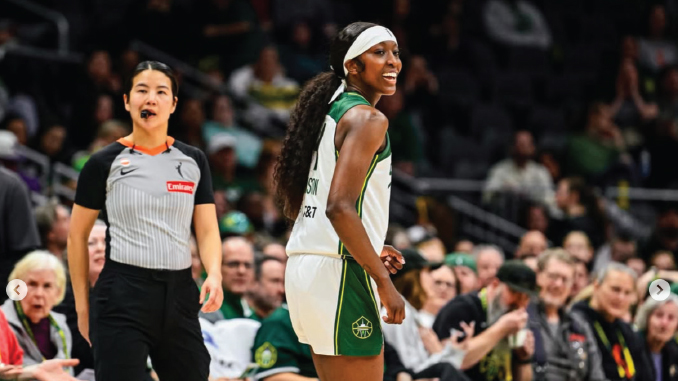
Flau’jae Johnson’s transition to the pro game appears equally accelerated. As the No. 8 pick, she’s already showing herself as more than a rookie learning the ropes. With 20 points in a 18-minute dash for the Seattle Storm, she’s projecting not just potential but a practical game-changing presence. What makes this especially interesting is Johnson’s efficiency curve. In a league that often rewards scoring instinct but penalizes inefficiency, her 5-of-12 shooting demonstrates growth: she’s converting opportunities while maintaining pace and defensive commitment. In my view, Johnson embodies a broader trend: the college-to-pro pipeline is now a fast-track to meaningful minutes for rookies who understand how to operate in multiple spaces—on-ball creator, secondary playmaker, and off-ball threat. People frequently underestimate how tough it is to sustain a high scoring pace in the preseason; Johnson’s efficiency, impact, and clock management tell a story of a rookie who’s made a conscious choice to lead rather than linger in the shadows.
Angel Reese’s debut with the Atlanta Dream against her former team, the Chicago Sky, adds an extra layer of narrative depth. She logged eight points, seven rebounds, two assists, and three steals in 13 minutes, and the Dream won 87-78. The dynamic here isn’t just about accounting for stats; it’s about a player stepping into a new culture and instantly contributing to a team’s chemistry and defensive identity. Reese’s varied stat line signals a player who doesn’t rely on one facet of her game to impact outcomes. From my vantage, this debut embodies a broader theme: high-usage college players—even those who carry championship narratives—must adapt to a new staff, new teammates, and new expectations quickly. Reese’s quick acclimation hints at how Mulkey’s disciples enter the pro ranks with a robust on-court literacy: they know how to read defenses, refill gaps on the backline, and convert hustle into momentum—qualities that translate into reliable rotation minutes in the blink of an eye.
Taken together, these early performances aren’t simply about LSU alumni succeeding in the WNBA. They’re a testament to a coaching philosophy that consistently builds players who combine physical tools with basketball IQ, rugged competitiveness, and a willingness to contribute in multiple ways. What this really signals is a shift in how young pros approach the league: they’re not waiting for a perfect system to fit into; they’re arriving with a blueprint for versatility and impact that forces teams to rethink lineups and rotation strategies from day one.
Deeper implications emerge when you consider the broader landscape. The WNBA is increasingly a league that rewards players who can do more than one thing well and do it with a certain intentionality—defense first, with a credible offensive threat, and a reliable motor. Mulkey’s players carry a particular signature: a blend of toughness, basketball IQ, and an instinct for clutch moments. The question this raises is whether other programs will begin to emphasize such multi-dimensional development to a degree that makes immediate pro readiness a baseline rather than an exception. If the trend holds, college programs may become even more decisive in shaping pro-ready players who aren’t just athletes; they’re basketball professionals in the most practical sense.
Of course, preseason performance is not destiny. But what sticks is the unambiguous message: LSU’s culture under Mulkey isn’t a one-season flourish. It’s a blueprint that’s producing players who walk into the league with a ready-made language for winning, not just potential. That’s the kind of development pipeline that could redefine how teams scout, value, and integrate top college talents in the near future.
In the end, the story isn’t about individual breakout games, but about a broader trend: a coaching ecosystem that consistently equips players with a toolkit that translates instantly to the professional game. If these early signs persist, Mulkey’s LSU pipeline might just become the gold standard for turning college success into sustained pro impact. Personally, I think that’s the kind of narrative journalism loves to chase—the moment when a program’s philosophy shows up where it matters most: on the world’s biggest stages.